

For years, artificial intelligence has been framed as a disruptive force in manufacturing — something that would replace operators, automate decision-making, and fundamentally change plant-floor roles. In the converting room, however, the reality is far less dramatic and far more practical.
AI in converting is not about replacing skilled operators. It’s about augmenting them.
In flexible packaging operations — where slitting, lamination, and printing depend on experience, intuition, and process control — AI’s value lies in turning operational data into foresight. When deployed correctly, AI becomes a quiet but powerful layer of intelligence that improves consistency, reduces waste, and helps operators make better decisions faster.
What AI Is Good At…and What It’s Not
One of the biggest misconceptions surrounding artificial intelligence in manufacturing is that AI “runs” equipment. In reality, AI excels at pattern recognition, prediction, and anomaly detection, not hands-on machine control.
What AI Does Well
- Detects subtle process deviations before visible defects appear
- Analyzes large datasets faster than human interpretation allows
- Identifies correlations between tension, speed, temperature, and defect rates
- Predicts maintenance needs based on historical and real-time machine data
What AI Does Not Replace
- Operator judgment during setup, changeovers, and troubleshooting
- Material intuition developed through years of converting experience
- Context-based decisions during unexpected process disruptions
- Accountability for quality-critical decisions
AI doesn’t replace expertise — it amplifies it.
Real-World AI Use Cases in the Converting Room
AI in Slitting: Tension Mapping and Roll Quality Prediction
In slitting operations, AI models ingest tension data, speed profiles, and rewind parameters to create predictive maps of roll quality. Rather than reacting to telescoping, starring, or edge damage after the fact, AI flags conditions that historically lead to poor roll formation before defects occur.
The result is improved roll consistency, tighter tolerances, and reduced downgraded material across shifts and operators.
AI in Lamination: Defect Detection and Process Stability
AI-driven vision systems in lamination detect voids, streaking, coating inconsistencies, and entrapped air with greater accuracy than traditional rule-based systems. These systems learn what acceptable variation looks like, reducing false rejects while still catching true defects.
Over time, AI also supports root-cause analysis tied to adhesive ratios, nip pressure, web alignment, and environmental conditions.
AI in Printing: Registration and Color Consistency Monitoring
In printing environments, AI supports advanced registration control and color drift monitoring by learning how inks, substrates, and press conditions interact over time. Continuous trend analysis allows operators to intervene before out-of-spec conditions occur.
This is especially valuable in short runs and frequent changeovers, where setup efficiency and waste reduction directly impact profitability.
Predictive Maintenance and Waste Reduction
One of AI’s most measurable advantages in converting operations is predictive maintenance. By monitoring vibration, motor load, temperature, and cycle counts, AI systems identify early signs of component wear — long before failure occurs.
Predictive maintenance enables:
- Planned maintenance instead of emergency downtime
- Reduced scrap caused by mid-run equipment failures
- Optimized spare parts inventory
- Improved machine availability and uptime
Waste reduction follows naturally. Predicting defects instead of discovering them leads to lower trim loss, fewer re-runs, and measurable sustainability gains.
Ethical and Workforce Considerations
The most important discussion around AI in manufacturing isn’t technical. It’s human.
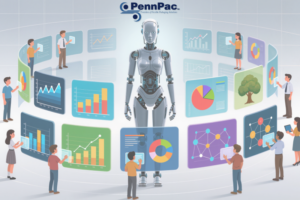
AI should never be positioned as a replacement for operators. When framed incorrectly, it creates fear and resistance. When framed correctly, it becomes a tool that reduces stress, improves safety, and protects jobs.
Successful AI implementations share common traits:
- Operators are trained to interpret AI insights
- Recommendations are transparent and explainable
- Human decision-making remains the final authority
- Data supports people rather than monitoring them punitively
In high-skill converting environments, operators remain the differentiator.
Beyond 2026: The Future of AI in Converting
Looking ahead, AI in the converting room will evolve as part of fully integrated manufacturing ecosystems rather than standalone tools. For more on 2026 trends, including AI, click here.
Near-Future Developments Include
- Cross-machine learning between slitters, laminators, and printers
- Real-time material behavior modeling by supplier and lot
- AI-assisted job setup recommendations based on historical outcomes
- Closed-loop quality systems that adjust parameters within defined limits

The most advanced converters won’t advertise “AI-powered machines.” They’ll simply deliver more consistent quality, lower waste, faster turnarounds, and fewer surprises. More on AI in packaging films here.
Conclusion: From Hype to Measurable Advantage
AI in the converting room is no longer a futuristic concept or a marketing buzzword. It is a practical, measurable advantage when applied thoughtfully and realistically.
The converters who succeed won’t chase automation headlines.
They’ll quietly use AI to support and encourage skilled operators, protect quality, and make smarter decisions in every production shift.