
In flexible packaging, film thickness is far more than an arbitrary number on a material specification sheet. Thickness influences how films perform on equipment, how well they protect a product, how much material is being used, and how profitable a package ultimately is.
Despite its importance, film thickness remains one of the most misunderstood and improperly measured properties in the industry. Across converting plants, end-user packaging lines, and distribution centers, it is not uncommon to see flexible films measured with tools that were never designed for thin films subject to compression.
When working with BOPP, PET, CPP, Nylon, or multi-layer barrier structures, small differences in gauge can create significant downstream effects. A few microns can change seal performance, stiffness, barrier properties, and machine settings. In today’s environment—where downgauging, sustainability goals, and material efficiency are driving thinner structures—accuracy matters more than ever. As tolerances tighten, the margin for measurement error continues to shrink.
Why Handheld Tools Fall Short
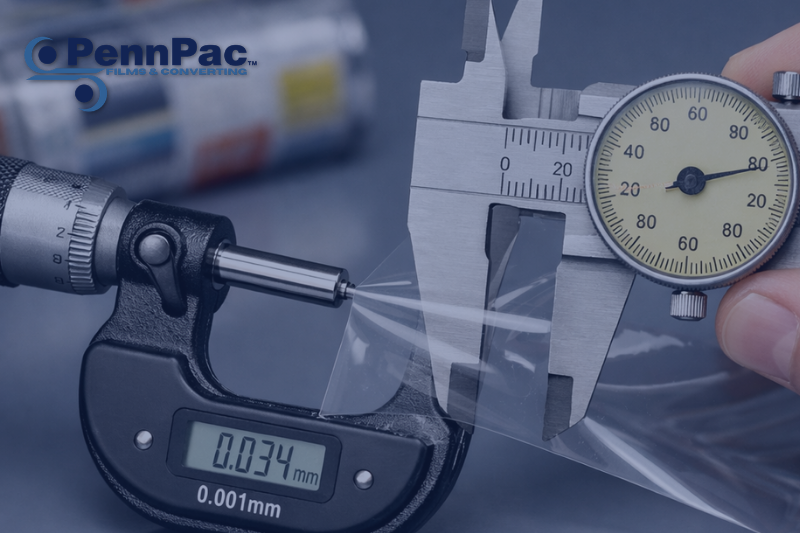
The most common measurement mistake begins with handheld micrometers and dial calipers. These tools are familiar, convenient, and widely available, so they often become the default option in many facilities. Unfortunately, they are designed primarily for rigid materials, not thin flexible films.
Even when high-quality instruments are used, they remain the wrong tool for the job. Using handheld devices to measure flexible packaging films can lead to errors exceeding 10 percent.
Flexible packaging films compress under pressure. When a handheld micrometer closes around a thin film, it does not simply touch the surface—it applies force. That force compresses and deforms the polymer structure, flattens surface texture, and forces out trapped air. As a result, readings are often lower than the true thickness.
While the compression may seem minor, it introduces meaningful error, particularly with films thinner than 50 microns.
Operator variability further compounds the problem. Different users apply different amounts of pressure, even when using the same tool. Two technicians measuring the same sample can easily produce different results because of the ratchet mechanism commonly used with micrometers. Over time, this inconsistency erodes confidence in the data and makes comparisons between shifts, facilities, or suppliers unreliable.
Dial calipers introduce another limitation: resolution. Most standard calipers measure to 0.001 inches, or one mil. In flexible packaging, this level of precision is often insufficient. Distinguishing between 1.20 mil and 1.30 mil film requires finer resolution. That 0.10 mil difference—approximately 2.5 microns—may seem minor, but it can affect barrier performance, stiffness, and yield in real applications.
The Role of Dead-Weight Micrometers
For accurate thickness measurement, the flexible packaging industry relies on dead-weight micrometers that conform to ASTM D374 standards.
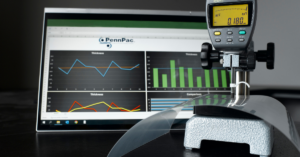
Unlike handheld devices, dead-weight micrometers apply a controlled, calibrated amount of pressure through a weighted mechanism. The contact foot is larger, distributing force evenly and minimizing localized compression.
This design eliminates much of the operator influence that affects handheld tools. Pressure remains constant regardless of who performs the measurement, resulting in readings that are more repeatable, comparable, and defensible.
In practical terms, this consistency is critical. Converters, distributors, and brand owners depend on thickness data to verify incoming material, monitor production quality, and issue certificates of analysis. Without standardized measurement methods, those documents lose credibility.
A 1.30 mil film measured in one lab must be comparable to a 1.30 mil film measured in another. Dead-weight micrometers make that possible.
For organizations serious about quality management, investing in calibrated, traceable dead-weight measurement equipment is foundational infrastructure.
Non-Contact Measurement in Film Manufacturing
In primary film manufacturing, thickness is often monitored continuously using non-contact systems such as beta gauges, infrared scanners, and X-ray measurement devices.
These systems provide real-time data across the entire web width, generating thickness profiles that help operators control extrusion and identify gauge bands.
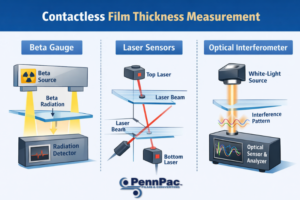
Such technologies are invaluable for process control. They allow producers to respond quickly to variation, optimize die settings, and improve uniformity. Over time, they also generate trend data that supports continuous improvement.
However, non-contact systems are not standalone solutions. They require regular calibration and verification against laboratory measurements. Even the most advanced online scanner ultimately depends on accurate bench data for validation. This reinforces the importance of proper contact measurement equipment in any quality system.
Environmental Conditioning and Sampling
Even with the correct tools, poor measurement practices can undermine accuracy.
One of the most overlooked factors is environmental conditioning. Film thickness should be measured in a controlled environment—typically around 23°C (73°F) and 50% relative humidity—in accordance with ASTM standards.
Temperature and humidity influence polymer behavior. Materials such as nylon are particularly sensitive to moisture. Measuring film immediately after it has been unloaded from a cold truck in winter or a hot trailer in summer introduces unnecessary variability. Allowing material to equilibrate before testing significantly improves consistency.
Sampling technique is equally important. Flexible film is rarely perfectly uniform across a roll. Thickness can vary across the web and along the length of the roll due to process conditions, winding tension, and material flow.
Relying on a single measurement point provides an incomplete picture. Taking multiple readings across the width and at different roll positions produces a more accurate representation of average gauge.
Measuring Laminated Structures
For single-layer films, thickness measurement is relatively straightforward. Laminated structures introduce additional complexity.
While total laminate thickness can be measured using standard methods, determining individual layer thickness requires more advanced techniques.
Cross-sectional analysis using optical microscopy allows technicians to measure individual layers such as PET, EVOH, Nylon, or sealant films. This type of testing is typically reserved for validation, troubleshooting, or customer qualification rather than routine quality checks.
Nevertheless, it plays an important role in high-barrier and specialty applications where layer distribution is critical.
The Importance of Unit Consistency
Another frequent source of confusion in film specifications is unit reporting.
In North America, thickness is often specified in mils or gauge, where 100 gauge equals one mil. In international markets, microns are the standard.
Miscommunication between these systems can lead to costly errors.
Confusing 120 gauge with 120 microns is not theoretical—it happens. A 120-micron film is more than four times thicker than a 120-gauge film. Standardizing internal documentation and clearly defining units on specifications, purchase orders, and certificates reduces risk and prevents misunderstandings.
Why Accuracy Matters More Than Ever
As the flexible packaging industry continues pursuing downgauging and sustainability goals, thickness control becomes increasingly critical.
Thinner structures offer material savings and environmental benefits, but they also reduce safety margins. Minor deviations that were once acceptable may now result in seal failures, barrier loss, or machine instability.
From a financial perspective, gauge variation directly affects yield. Over-gauging increases material cost, while under-gauging increases risk.
Accurate measurement enables companies to operate closer to target specifications with confidence.
Equally important is trust. Customers rely on suppliers to provide accurate, consistent data. When thickness measurements are unreliable, it undermines confidence and complicates supplier relationships. Conversely, strong measurement practices strengthen credibility and long-term partnerships.
Getting the Basics Right
Accurate thickness measurement is not about chasing perfection or adding unnecessary complexity. It is about doing the fundamentals correctly.
Using calibrated dead-weight micrometers, conditioning samples properly, following consistent sampling procedures, and maintaining traceable records form the backbone of a reliable quality system.
These practices protect everyone in the supply chain—from resin producers and film manufacturers to converters, brand owners, and retailers. They ensure that the material being produced, sold, and used is exactly what it is supposed to be.
Thickness may appear to be a small number on paper. In reality, it drives performance, efficiency, sustainability, and profitability. Measuring it correctly is not just a technical exercise—it is a business imperative.