
Introduction
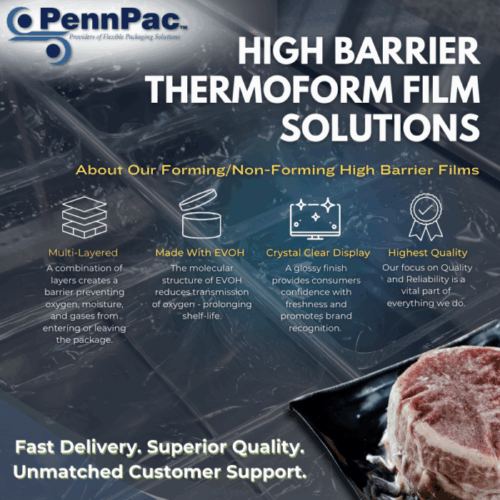
In the food packaging industry, thermoforming films play a vital role in protecting products. These robust films extend shelf life and enhancing consumer appeal. Choosing the right film gauge thickness directly impacts durability, sealing performance, and barrier protection. For packaging engineers, understanding how to select the appropriate thermoforming film thickness is critical to ensuring product safety, cost-effectiveness, and regulatory compliance.
The Role of Thermoforming Films in Food Packaging
Thermoforming films play a critical role in today’s food packaging industry by offering the strength, flexibility, and barrier properties needed to protect a wide range of products. By heating and shaping the film into custom forms, manufacturers can create durable packages that preserve freshness and extend shelf life. All the while, providing clear visibility and branding opportunities. Whether used for fresh meats, cheeses, frozen foods, or ready-to-eat meals, thermoforming films provide both functional and aesthetic advantages that support food safety and consumer appeal. By selecting the correct film thickness, engineers can design packaging that meets both product requirements and supply chain demands.
- In fresh protein applications such as meat and poultry, thermoforming films serve as the bottom web that tightly conforms around the product. Then, a lidding film (top web) seals the package. These structures balance puncture resistance, oxygen barrier properties, and sealing strength to ensure product integrity.
- For dairy and cheese products, thermoforming films are often engineered with advanced barrier layers like EVOH. Ultimately, to prevent oxygen ingress and maintain flavor, color, and texture.

- Frozen and convenience foods also rely heavily on thermoforming films. Gauge thickness provides puncture resistance for sharp or irregular items, while moisture barrier performance reduces freezer burn and ice crystallization. At the same time, clear and printable surfaces allow manufacturers to communicate essential information such as nutrition facts, cooking instructions, and branding.
- By combining functionality with visual appeal, thermoforming films help food manufacturers meet both regulatory requirements and consumer expectations.
Gauge Thickness and Its Impact on Food Applications
Film gauge thickness, typically measured in mils or microns, is one of the most important parameters in food packaging. Thicker films provide superior mechanical strength, puncture resistance, and barrier performance. As such, making them ideal for demanding applications like protein packaging. Thinner films, on the other hand, are well suited for high-volume snack, bakery, or portion-pack runs, where flexibility and cost savings are essential. Engineers must balance durability, barrier needs, and cost-per-unit when selecting the right gauge.
Specifically, in protein thermoforming applications, film gauge thickness is a decisive factor in ensuring package integrity, food safety, and shelf life. The bottom forming web requires sufficient thickness to provide deep draw capability without thinning excessively in corners or edges. This could compromise puncture resistance around bone-in cuts or irregular protein shapes. Thicker gauges in the bottom layer also enhance structural strength to withstand mechanical stresses during transport and cold storage.
Conversely, the top lidding film is typically engineered with a slightly thinner gauge. More so, balancing clarity for product visibility with reliable sealing performance. Its thickness must be optimized to deliver strong seals while maintaining controlled peel strength for consumer convenience.
Together, the gauge selection of both top and bottom layers determines the barrier performance (OTR and MVTR), puncture resistance, and overall durability of protein packaging. Thus, making it a critical design variable for packaging engineers. More about OTS and MVTR below.
Forming Temperature Ranges in Thermoforming Films
The forming temperature range is a critical factor in ensuring that thermoforming films perform correctly during processing. Properly controlled temperatures allow films to form tightly around food products. As such, producing consistent seals without voids or thin spots. Incorrect temperature settings can compromise package integrity and increase contamination risk(s). For this reason, engineers should always reference manufacturer datasheets to identify the recommended forming temperatures for food-grade films. Read more about seal temperatures in flexible packaging films here!
Sealability and Peel Strength for Food Safety
Seal integrity is one of the most important performance measures in food packaging. Strong, reliable seals prevent contamination, preserve freshness, and extend shelf life. At the same time, engineers must consider peel strength to balance consumer convenience with safety. A weak seal can result in leaks, while overly strong seals may frustrate consumers as they may too difficult to open. To standardize, ASTM testing methods, such as F88 for seal strength, provide reliable standards for evaluating performance and ensuring consistent food safety outcomes.

Oxygen Transmission Rate (OTR) in Food Packaging
Oxygen transmission rate (OTR) is a critical barrier property that determines how well a film protects perishable products from oxidation.
- An OTR quantifies the amount of oxygen gas that permeates through a given area of film over a specified time. Typically, expressed in cc/m²/day at controlled conditions of temperature and relative humidity.
- Low OTR values are essential for meats, cheeses, and prepared meals where oxygen exposure can reduce shelf life and product quality.
- Multilayer films incorporating EVOH or metallized barriers are often used to achieve the required performance.
Engineers should carefully evaluate OTR specifications to ensure packaging aligns with expected distribution timelines and storage conditions. Understanding and controlling OTR is essential because oxygen exposure drives oxidation, microbial growth, discoloration, and flavor degradation in perishable foods.
Moisture Vapor Transmission Rate (MVTR) in Food Packaging
Controlling moisture activity is equally as important with maintaining product quality.
- Moisture Vapor Transmission Rate (MVTR) measures the passage of water vapor through a film over time. Often, expressed in g/m²/day under defined conditions of temperature and relative humidity. For food packaging engineers, MVTR is a critical performance parameter because moisture migration can dramatically affect product stability, texture, flavor, and shelf life.
- Target MVTR must align with the product’s shelf life and distribution cycle. For example, a dry snack package may require MVTR below 0.5 g/m²/day, while a fresh produce film may allow higher values to prevent condensation.
A low MVTR helps keep baked goods crisp, prevents condensation in fresh produce packaging, and protects frozen foods from ice crystallization. Engineers can optimize moisture protection through proper film thickness selection and the use of layered film structures designed to reduce water vapor permeability.
Puncture Resistance for Fresh and Frozen Foods
Robust puncture resistance is a critical property of thermoforming films used in protein, dairy, and frozen food applications. During processing, transport, and storage, food packages encounter mechanical stresses such as handling pressure, stacking loads, and impacts from irregular product surfaces. For fresh and frozen proteins in particular, sharp edges, bones, and ice crystals present a high risk of film failure if puncture resistance is insufficient.
Bottom Web (Forming Film)
- The forming web in thermoforming applications bears the greatest mechanical stress because it conforms tightly around the product during a deep draw. Engineers must select a film gauge thick enough to maintain uniform wall thickness after forming. Particularly in corners and draw areas. Materials such as Nylon (PA) or coextruded Nylon/PE blends are often used in bottom webs because nylon provides excellent puncture resistance without sacrificing flexibility.
Top Web (Lidding Film)
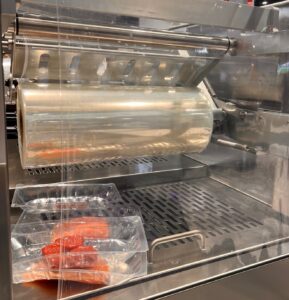
- The top web also requires puncture resistance. However, its primary role is sealing integrity and visibility. For frozen foods or bone-in proteins, top webs may be engineered with PET or PET/PE structures that balance clarity with toughness. Controlled gauge thickness ensures that the lid does not rupture during handling, sealing, or distribution.
In summary: puncture resistance is directly linked to gauge thickness, resin selection, and processing conditions. For fresh and frozen foods, optimizing puncture resistance ensures not only mechanical protection but also prevents oxygen or moisture ingress that could compromise shelf life and food safety.
Printability for Food Branding and Compliance
Printability is a critical property in thermoforming films because it directly impacts branding, regulatory compliance, and consumer communication. Engineers must ensure that the selected film structure and surface treatment support high-quality, durable printing that withstands both production and distribution conditions.
Surface Energy and Treatments
Print adhesion depends largely on the surface energy of the film. Untreated polyolefins like Polyethylene (PE) and Polypropylene (PP) have inherently low surface energy, which reduces ink wettability. To enhance printability, films are typically treated with corona, flame, or plasma treatments. These processes raise surface energy to around 38–42 dynes/cm, which allows inks and coatings to bond effectively.
Gauge Thickness and Film Structure
Film thickness can influence print quality. Thicker forming webs may develop surface texture variations after thermoforming, which can cause ink spreading or inconsistent adhesion. Engineers often specify thinner lidding films for printed areas because they retain smoother surfaces, ensuring consistent print resolution.
Multilayer films can also include print-receptive layers (e.g., modified PE or acrylic coatings) to improve printability without compromising barrier performance.
Ink and Printing Method Compatibility
Thermoforming films must be compatible with the chosen printing process:
-
Flexographic printing is commonly used for high-volume runs.
-
Gravure printing provides superior resolution for detailed graphics and fine text.
-
Digital printing offers flexibility for shorter runs and customization but requires precise ink/film compatibility.
Inks must also be tailored to the application. Solvent-based inks adhere well to treated films, while UV-curable inks offer durability and resistance to abrasion. Engineers must confirm ink compatibility with both the substrate and food-contact safety standards (e.g., FDA or EU regulations).
Engineering Considerations
-
Forming Distortion – During thermoforming, printed graphics can stretch or warp in deep-draw areas. Engineers must account for print distortion compensation in the artwork design.
-
Durability Testing – Print quality should be evaluated under conditions simulating distribution, refrigeration, and consumer handling. Abrasion resistance, scuffing, and ink adhesion tests are essential.
-
Regulatory Compliance – Nutritional information, allergen labeling, and date codes must remain legible throughout shelf life. Engineers must ensure both film and ink systems comply with relevant food safety regulations.
In short: printability is not just about aesthetics — it’s an engineered property that depends on surface treatment, gauge thickness, ink selection, and process conditions. Optimizing these factors ensures that thermoforming films deliver both functional performance and high-impact shelf appeal.
How to Interpret Food-Grade Film Datasheets
Engineers evaluating thermoforming films for food packaging often focus on key datasheet parameters. For example; gauge thickness, OTR, MVTR, seal strength, puncture resistance, and forming temperature ranges. Aligning these specifications with application needs ensures both performance and compliance. It is also important to use standardized testing methods and units when comparing suppliers. Whenever possible, in-house validation testing should supplement datasheet review.
Key Values in Flexible Film Datasheets
1. Gauge Thickness and Tolerance
-
Definition: Film thickness is typically measured in mils, microns, or gauge. Often, with an allowable variation (± %).
-
Importance: Thickness influences durability, barrier performance, and draw depth in thermoforming.
2. Barrier Properties
-
OTR (Oxygen Transmission Rate): Measured in cc/m²/day; critical for shelf life in protein, dairy, and ready meals.
-
MVTR (Moisture Vapor Transmission Rate): Measured in g/m²/day; essential for bakery, frozen, and produce packaging.
3. Thermal Properties
-
Forming Temperature Range: Defines the heat window for deep draws without thinning or ruptures.
-
Seal Initiation Temperature & Range: Ensures consistent hermetic seals.
-
Peel Strength: Expressed in N/15 mm; balances consumer convenience with package integrity.
4. Mechanical Properties
-
Puncture Resistance: Measured in N; indicates protection against bone-in meats, frozen edges, or transport stress.
-
Tensile Strength & Elongation at Break: Expressed in MPa and %; determine flexibility and toughness.
5. Surface and Printability Characteristics
-
Surface Energy: Dynes/cm value (typically ≥38 dynes) shows readiness for ink adhesion.
-
Treatment Type: Corona, flame, or plasma treatment methods are often noted.
Conclusion
For engineers in food packaging, selecting the right thermoforming film gauge thickness means balancing performance, safety, and cost efficiency. Factors such as seal integrity, oxygen and moisture barrier properties, puncture resistance, and printability must all be considered when choosing the appropriate film. By carefully analyzing datasheets, consulting with suppliers, and validating specifications, engineers can make informed decisions that ensure fresher, safer products and stronger competitive positioning in the marketplace.
At PennPac, we understand that selecting the right thermoforming film is as much about engineering performance as it is about supply reliability. Our portfolio includes a wide range of food-grade forming and lidding films with tailored barrier properties, puncture resistance, and print-ready surfaces to meet the demands of protein, dairy, frozen, and ready-meal applications. Whether you need technical guidance on datasheets, support in optimizing film gauge selection, or access to stateside inventory and custom slitting, PennPac is here to help make your thermoforming project a success.
Start your conversation today!